

Logistics in 2026 requires strong strategic logistics management.
In 2025, shippers were forced to maintain strict control over the supply chain. Sudden tariff implementations taught managers to include flexibility to overcome external changes. And real-time visibility became a must-have to adapt quickly.
Your strategy may have worked in 2025, but 2026 logistics is going to make some changes.
Ensure your supply chain strategy aligns with the 2026 logistics threat forecast.
The 2025 logistics results pave the way for 2026 best practices
The year 2026 will demand that U.S. supply chain leaders build on the foundations laid in 2025 and tackle new challenges with agility. In 2025, many companies invested heavily in real-time visibility systems and control towers to gain end-to-end oversight of shipments and inventory.
About 50% of large enterprises had adopted supply chain control towers for real-time visibility. Studies report that companies that leveraged real-time data cut logistics costs by 15%. Major investments in visibility and “single source of truth” data platforms have improved reaction speed, and 79% of firms now have end-to-end visibility dashboards.
The focus going forward is to evolve these capabilities from reactive monitoring to predictive and prescriptive planning.
At the same time, 2025 underscored the importance of resilience and flexibility. Companies established control towers and command centers to navigate port congestion, weather disruptions, and volatile freight markets. Many also built up inventory buffers and secondary suppliers as stopgaps.
Sustainability rose on the agenda, too. For example, retail giant Walmart announced it had already achieved its goal of eliminating one billion tons of CO₂ from its supply chain, six years ahead of its 2030 target. These 2025 trends set the stage for 2026. It will be a year of moving from recovery to intelligent transformation of supply chains.
In 2026, U.S. logistics and procurement leaders will need to balance operational priorities, like controlling costs amid shifting freight markets, with strategic initiatives, such as redesigning networks or adopting AI at scale.
Let’s outline the most important focus areas for 2026 and delve into each with detailed explanations and industry-specific examples across retail, food and beverage, pharmaceuticals, industrial manufacturing, automotive, FMCG, and e-commerce.
Supply chain network redesign
The previously exposed fragility of over-globalized and just-in-time models lays the foundation for restructuring supply chain networks to reduce risk and improve service, rather than just cut costs.
Shippers expect accelerated nearshoring and regionalization.
Most companies are starting to redesign networks with multiple suppliers, ports, DCs, and routes.
Networks are changing from static to flexible. Shippers use scenario modeling and digital twins to rebalance sourcing, inventory, and fulfillment as conditions change. Multi-node fulfillment, backup suppliers, and diversified ports are now the number one priority.
In 2026, network redesign will consist of resilience and optionality. Leaders already justify investments not only by cost, but by risk reduction, service reliability, and the ability to adapt when disruption hits.
Digital supply chain integration with real-time visibility
Making visibility tools mandatory in 2025 set the groundwork
for using them to orchestrate decisions in real time as a must in 2026. Most large enterprises already have end-to-end dashboards, but the main focus is to turn them into control towers that predict disruptions and trigger coordinated actions.
Companies already integrate data across suppliers, logistics, and demand into a single source of truth.
About 50% of large enterprises had adopted supply chain control towers for real-time visibility.
Studies show that companies that leverage real-time data cut logistics costs by 15%.
Major investments in visibility and “single source of truth” data platforms have improved reaction speed, as 79% of firms now have end-to-end visibility dashboards.
Digital twins and scenario simulation are becoming a baseline for risk planning.

Capacity management
After years of volatility, shippers treat capacity as a portfolio risk, rather than a single contract.
Analysts expect truckload capacity tightening by late 2026, with potential double-digit rate increases.
Reliance on one carrier or mode is now considered a structural risk. Shippers mix contracted freight with dynamic spot/index-linked sourcing. They are opting for multi-carrier routing guides, strong “shipper of choice” practices, and growing use of digital freight platforms and intermodal alternatives.
The capacity strategy in 2026 focuses on always having another truck, mode, or partner ready.
Agile procurement and supplier management transformation
Procurement shifts from transactional buying to AI-enabled, risk-aware value creation.
93% of supply chain executives plan to increase resilience through supplier diversification and safety stock. Procurement is now becoming a key driver of ESG, resilience, and innovation.
Shippers leverage AI for handling sourcing, RFPs, risk monitoring, and contract analysis, as well as risk dashboards, dual sourcing, and SRM programs.
It’s already known that source-to-pay platforms automate 70%+ of transactional procurement in advanced organizations. Continuous sourcing replaces rigid annual contracts
In 2026, procurement is faster, more autonomous, and more strategic because shippers focus on relationships, risk management, and AI.
Sustainability as a core supply chain mandate
Sustainability is no longer optional. Supply chains drive the majority of Scope 3 emissions, putting logistics and sourcing at the center of ESG strategy.
Many U.S. enterprises commit to double-digit Scope 3 emission reductions by 2030.
ESG requirements increasingly influence supplier selection, contracts, and network design. However, in 2026, shippers need carrier diversification one way or another. Also, this pays off in the company’s reputation in the eyes of end customers, from a marketing point of view.
To succeed, companies use circular supply chains, which include reuse, recycling, and design-for-disassembly.
Shippers focus on sustainable transport with EVs, optimized routes, and mode shifts, along with supplier ESG scorecards, traceability, and automated reporting of carbon, water, and waste.
In 2026, carbon, ethics, and cost are managed together, often inside the same control tower.
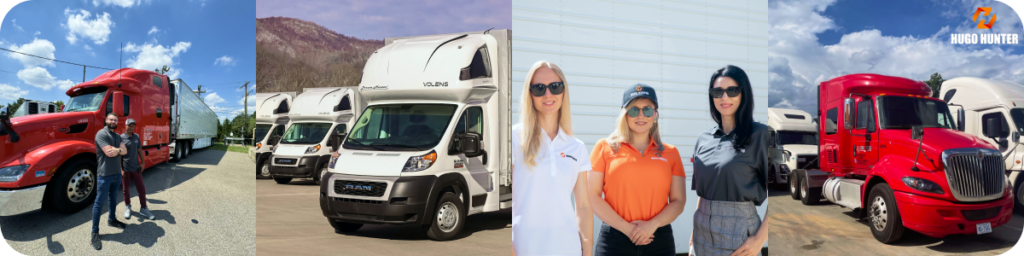
Hugo Hunter as a strategic solution in 2026
For years, Hugo Hunter has been a reliable logistics partner for many companies.
At Hugo Hunter, we combine industry-specific knowledge with a tailored approach to help shippers keep their supply chain resilient and innovative.
Stay confident about tomorrow with complete control over your shipments.
Leverage real-time visibility and an easily scalable fleet that powers your logistics with flexibility. Manage your shipment data to overcome unexpected disruptions and implement sudden changes.
We meet your unique needs with a wide range of services.
- Temperature-controlled freight services
- Less-than-truckload shipping (LTL)
- Full truckload shipping (FTL)
- Flatbed shipping
- Expedited delivery
- Last-Mile delivery
- Drop Trailer services
- Cross-Docking services
- Warehouse services
Let’s build your innovative supply chain that is ready for whatever comes next in 2026! Partner with the Hugo Hunter team.
Conclusion
2026 demands that U.S. supply chain leaders build on the foundations laid in 2025 and tackle new challenges with agility.
In 2025, many companies invested heavily in real-time visibility systems and control towers to gain end-to-end oversight of shipments and inventory. The focus going forward is to evolve these capabilities from reactive monitoring to predictive and prescriptive planning.
At the same time, 2025 underscored the importance of resilience and flexibility.
In 2026, U.S. logistics and procurement leaders will need to balance operational priorities with strategic initiatives to succeed.